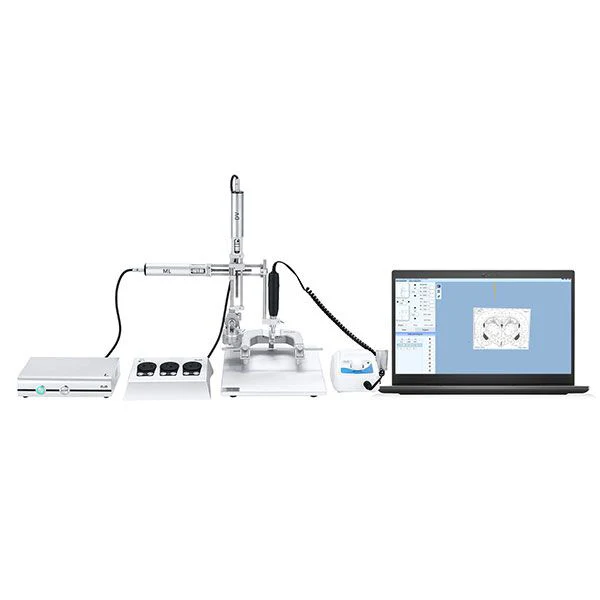
Scientific researchers often inquire about the physical constraints of laboratory equipment to ensure compatibility with their specific experimental designs. BPLabLine provides detailed specifications for the automated stereotaxic Instrument to assist in these technical evaluations. By understanding the spatial boundaries of the stereotaxic apparatus, laboratory personnel can better plan electrode implantations or injection protocols across various cranial regions.
Three-Dimensional Movement Range
The standard stereotaxic apparatus utilizes a precise mechanical frame designed to cover the entire skull of common small laboratory animals. Specifically, the 71000 automated stereotaxic Instrument features an operating arm that moves along the AP, ML, and DV axes. They report that this automated stereotaxic Instrument offers a total movement range of 80mm in each dimension, typically represented as ±40mm from the center. This 80mm displacement ensures that the stereotaxic apparatus remains versatile enough for diverse surgical procedures involving both mice and rats.
Precision and Resolution Limits
Beyond the external physical dimensions, the functional working range is also defined by the resolution of the movement. Within the 80mm span, the automated stereotaxic Instrument maintains a positioning accuracy of 1 μm. High-precision screws within the stereotaxic apparatus allow for these minute adjustments, which are critical when targeting small nuclei within the brain. They have engineered the system so that every 18-degree rotation of the control knob corresponds to exactly 1 μm of displacement, providing a highly granular working range for the user.
Automated Procedure Parameters
Software-integrated functions define the practical working range for specific surgical tasks. When utilizing the 71000 automated stereotaxic instrument for craniotomies or tissue removal, the adjustable parameters for length, width, and diameter are fully configurable within the software’s operational boundaries. Additionally, the DV axis depth for these automated programs is managed through precise software-defined limits. These configurations ensure that the apparatus operates safely within its mechanical capacity while providing ample clearance for standard neurosurgical interventions.
Technical specifications regarding the 80mm displacement and 1 μm resolution characterize the spatial capacity of these systems. BPLabLine ensures that each automated stereotaxic Instrument meets these rigorous standards for experimental consistency. Because the stereotaxic apparatus integrates with digital atlases, the working range is not merely a physical limit but a precisely mapped coordinate system for neuroscience research.