Choosing among industrial gas burner manufacturers requires more than comparing burner prices or output ratings. Industrial buyers are selecting a combustion partner whose equipment must work within specific fuel, pressure, temperature, control, and installation conditions. A credible evaluation therefore asks what the manufacturer can demonstrate before the purchase, not simply what appears in its product catalog.
Does the Manufacturer Understand the Buyer’s Combustion Application?
The first question should be whether the manufacturer evaluates the process before recommending equipment. An industrial burner cannot be selected accurately from heat capacity alone. Fuel type, gas pressure, required output, furnace or oven configuration, operating conditions, and control requirements can all affect suitability.
A manufacturer with application knowledge should be able to discuss these parameters and identify information still needed for burner selection. That technical conversation gives buyers an early indication of whether the supplier is selling a standard product or actually assessing the combustion duty.
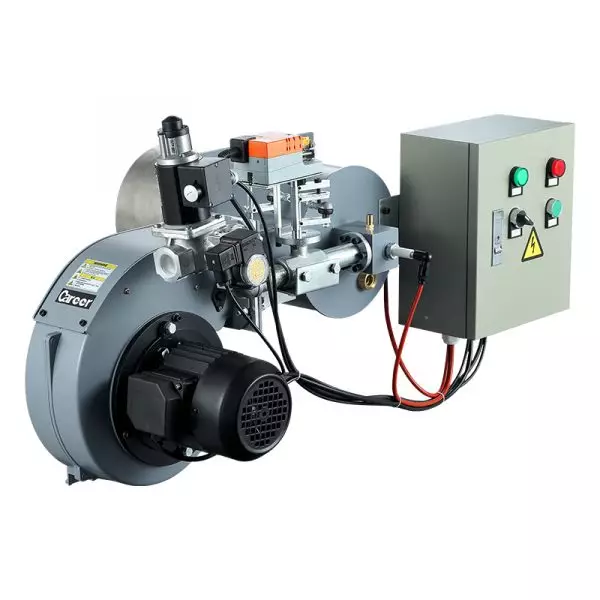
Career Burner, for example, identifies its industrial range as nozzle-mixing burners designed for direct-fired industrial applications. Its published information also identifies compatibility with natural gas, LPG, and biogas.
Can the Manufacturer Prove That Its Burners Fit the Process?
Product specifications should be examined against the actual operating requirements rather than accepted at face value. Buyers should request information covering capacity, fuel requirements, operating pressure, burner configuration, control method, dimensions, and other parameters relevant to installation.
The published industrial range from Career Burner covers capacities from 5.3 kW to 348.3 kW. Its BX series is described as nozzle-mix equipment with a turndown ratio of up to 40:1. Such published figures give engineering teams concrete information for an initial suitability assessment.
Industrial gas burner suppliers should also be able to discuss existing-system compatibility. The manufacturer specifically recommends checking fuel type, pressure, and output requirements when assessing whether its burners can be integrated into an existing setup.
That verification matters during both new installations and burner replacement projects, where physical or operational constraints may already exist.
Does the Manufacturer Demonstrate Consistent Manufacturing Quality?
Manufacturing capability is another factor buyers should verify because burner performance depends on consistent construction and component quality. A supplier should be able to explain how products are manufactured and what quality-management practices support production.
Formal quality systems can provide useful evidence. The referenced manufacturer states that its production is ISO 9001-certified and describes its approach as combining precision design with customized combustion solutions.
Buyers can use this information as a starting point, then request the documentation relevant to their project. Questions about inspection, testing, traceability, and component availability can reveal how much manufacturing control exists behind the quoted product.
Price comparisons become more meaningful after this technical baseline has been established. A lower initial quotation may not represent equivalent procurement value if documentation, configuration support, or replacement-part access is limited.
Can the Manufacturer Handle Customized Burner Requirements?
Industrial equipment frequently has requirements that do not correspond perfectly with an off-the-shelf configuration. A manufacturer should therefore be able to identify which burner characteristics can be adapted and which requirements fall outside the standard design.
Career Burner states that it provides customized solutions and engineering assistance for compatibility assessments. Its industrial burners are also described as suitable for direct-fired applications including ovens, dryers, paint-finishing lines, paper and textile machinery, food-baking equipment, coffee roasters, grain dryers, and fume incinerators.
For buyers, the important issue is not the length of an application list. The better question is whether the manufacturer can explain how its equipment relates to the specific process under consideration.
Will the Manufacturer Support the Burner After Delivery?
A burner supplier’s responsibility should not effectively end when the equipment leaves the factory. Commissioning, troubleshooting, maintenance, and replacement parts can become important once the system enters operation.
Career Burner states that its burners carry a one-year warranty from the date of manufacture. It also identifies post-warranty technical assistance, troubleshooting, and part replacement as available support services, subject to applicable charges.
The product information recommends professional installation and identifies routine maintenance activities such as cleaning filters, inspecting nozzles, and checking fuel flow.
Industrial gas burner suppliers should therefore be assessed on more than warranty duration. Buyers should establish how technical questions are handled, whether replacement components can be obtained, and what assistance is available when operating problems occur.
Does the Manufacturer Provide Clear Commercial and Technical Information?
A strong supplier evaluation ends with verifiable information. Buyers should compare technical documentation, warranty conditions, customization terms, delivery expectations, and support arrangements before making a purchasing decision.
Lead time is particularly relevant to planned shutdowns and equipment replacements. Career Burner states that in-stock products can receive seven-day fast shipping, while custom orders are listed at approximately 2.5 weeks, with a more precise schedule provided after order confirmation. Project-specific timing should still be confirmed before procurement.
The final shortlist should therefore favor a manufacturer that can answer technical questions clearly, document the proposed configuration, and establish realistic commercial commitments. Career Burner provides published information covering its industrial burner range, fuel compatibility, capacity, customization, warranty, and delivery terms, giving buyers several concrete points for supplier evaluation.
The best manufacturer is not necessarily the one with the lowest quotation or the largest catalog. Industrial buyers should look for demonstrated application knowledge, documented product suitability, controlled manufacturing, customization capability, dependable technical support, and transparent commercial information. Those criteria provide a much stronger basis for selecting a combustion supplier that can support the equipment throughout its operating life.